e, Taylor/MacLaurin and Euler
On this page I want to show a few important results in mathematics
and finish with Euler's famous equation.
The main point of this page is to show that there are no "short cuts"
needed in mathematics. Some text books or web pages will state
"let \(e^{ix}= cos(x) + i \quad sin(x)\)". But there is no "let" involved.
This is an identity more than an equation.
Elsewhere on this web site I have
described the origin of Euler's
number
\(e= \lim_{n \to \infty} (1+ 1/n)^n = 2.718.....\) and in
the rest of this page I want to explore \(e\) further.
Before I do, there are a few more results we need.
The first is the expansion of \(sin(a+b)\).
Figure 1 shows a set of right-angle triangles
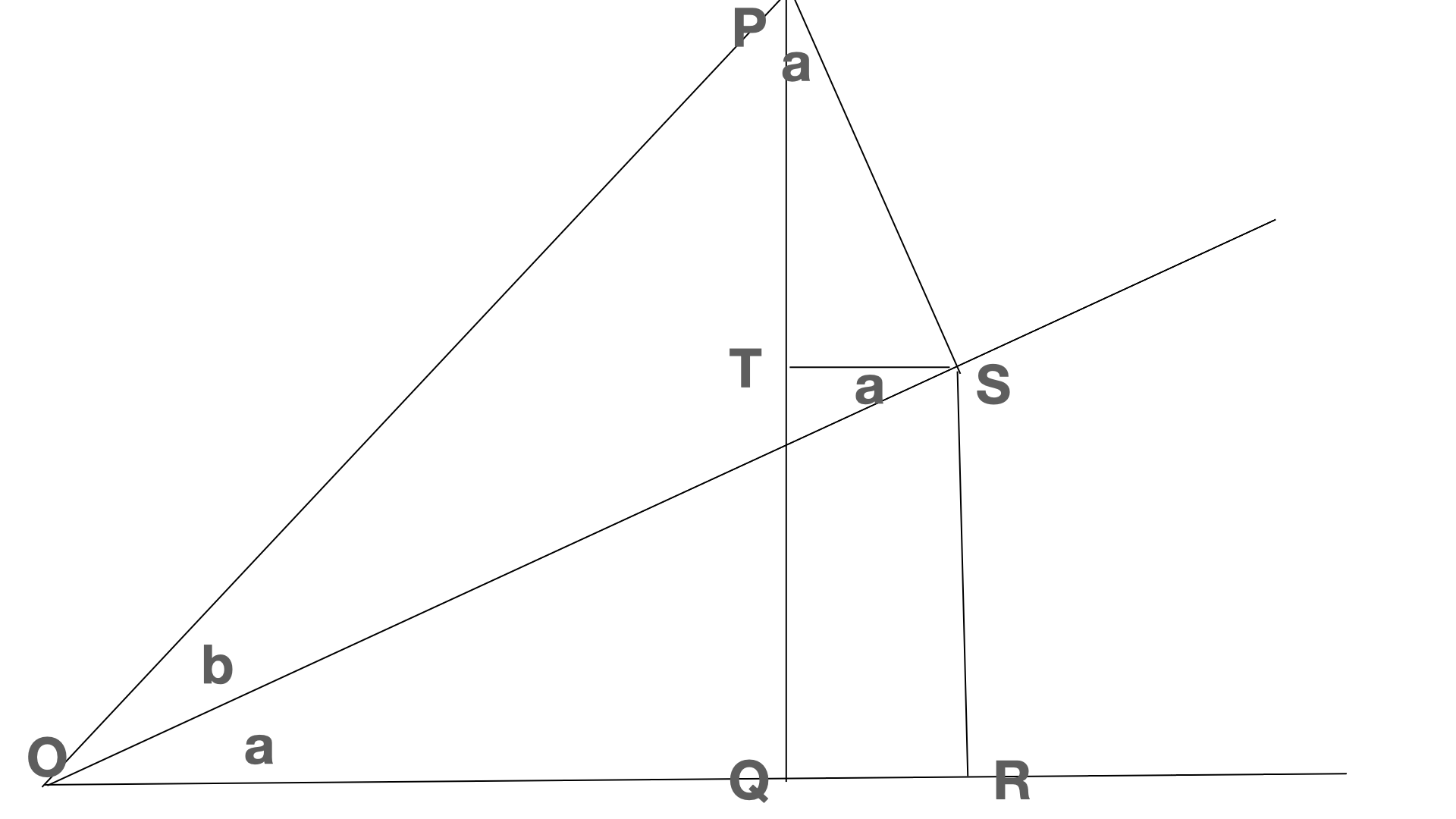 $$sin(a+b) = \frac{PQ}{OP}$$
$$sin(a+b) = \frac{PT+TQ}{OP}$$
$$sin(a+b) = \frac{PT}{OP} + \frac{TQ}{OP}$$
We can see that RS is the same length as TQ.
$$sin(a+b) = \frac{PT}{OP} + \frac{RS}{OP}$$
Multiply the first term on the right by \(\frac{PR}{PR}\).
$$sin(a+b) = \frac{PT}{PR} \times \frac{PR}{OP} + \frac{RS}{OP}$$
Now multiply the second term by \(\frac{OR}{OR}\).
$$sin(a+b) = \frac{PT}{PR} \times \frac{PR}{OP} + \frac{RS}{OR}\times
\frac{OR}{OP}$$
$$sin(a+b) = \frac{PT}{PR} \times \frac{PR}{OP} + \frac{RS}{OR} \times
\frac{OR}{OP}$$
From the triangle PTR, \(cos(a)= \frac{PT}{PR}\).
$$sin(a+b) = \frac{PQ}{OP}$$
$$sin(a+b) = \frac{PT+TQ}{OP}$$
$$sin(a+b) = \frac{PT}{OP} + \frac{TQ}{OP}$$
We can see that RS is the same length as TQ.
$$sin(a+b) = \frac{PT}{OP} + \frac{RS}{OP}$$
Multiply the first term on the right by \(\frac{PR}{PR}\).
$$sin(a+b) = \frac{PT}{PR} \times \frac{PR}{OP} + \frac{RS}{OP}$$
Now multiply the second term by \(\frac{OR}{OR}\).
$$sin(a+b) = \frac{PT}{PR} \times \frac{PR}{OP} + \frac{RS}{OR}\times
\frac{OR}{OP}$$
$$sin(a+b) = \frac{PT}{PR} \times \frac{PR}{OP} + \frac{RS}{OR} \times
\frac{OR}{OP}$$
From the triangle PTR, \(cos(a)= \frac{PT}{PR}\).
From the triangle POR, \(sin(b)=\frac{PR}{OP}\).
From ORS we get \(sin(a)= \frac{RS}{OR}\).
From ORP we have \(cos(b)=\frac{OR}{OP}\).
Hence,
$$sin(a+b) = cos(a)sin(b) + sin(a)cos(b) \hspace{3cm} Result \quad 1$$
Now let's find \(cos(a+b)\).
$$cos(a+B)= \frac{OQ}{OP}$$
$$cos(a+B)= \frac{OS-QS}{OP}$$
$$cos(a+B)= \frac{OS}{OP}-\frac{QS}{OP}$$
$$cos(a+B)= \frac{OS}{OP}-\frac{TR}{OP}$$
Multiple the first term on the right by \(\frac{OR}{OR}\)and
the second term by \(\frac{PR}{PR}\).
$$ cos(a+b) = \frac{OS}{OR}\frac{OR}{OP}-\frac{TR}{PR}\frac{PR}{OP}$$
$$cos(a+b)= cos(a)cos(b) - sin(a)sin(b)\hspace{2cm} Result \quad 2$$
Next, we need an equation relating \(cos\) and \(sin\).
From Figure 1,
$$cos(a) = \frac{OR}{OS}$$.
And
$$sin(a) = \frac{SR}{OS}$$
Bu we know what
$$SR =\sqrt{ \left( {OS}^2 - {OR}^2 \right)}$$
Thus
$$ {SR}^2 = {OS}^2 - {OR}^2 $$
Divide both sides by \({OS}^2\).
$$ \frac{ {SR}^2}{{OS}^2} = 1 - \frac{ {OR}^2}{{OS}^2 }$$
$$ sin^2(a) = 1 - cos^2(a) $$
$$ cos^2(a) + sin^2(a) =1 \hspace{3cm} Result \quad 3$$
There are two more results I need,
the derivative of sin(x) with respect to x, and the derivative of cos(x)
with respect to x.
What does derivative mean. In the context of algebra and equations,
it means the slope of the graph. So if we have \(y=sin(x)\) then the
derivative
of y with respect to x is the slope of the graph at the point(x,y).
One can measure this manually by zooming in microscopically to the point (x,y)
and measuring the slope with a ruler. One would measure a
really small
change in the x value and the corresponding change in the y
value
and the slope is
this change in y divided by the change in x.
In mathematics, the conventional symbol for "a small change in" is the
Greek letter \(\Delta\). A small change in y is denoted by \(\Delta y\)
so the slope is \( \frac{\Delta y}{\Delta x}\).
So, let us look at finding the derivative of \(sin(x)\), (the slope of \(sin(x)\)
).
$$y = sin(x) \hspace{4cm} Equation \quad 1$$
For an extremely small change in x there is an extremely small
change in y.
$$ y+ \Delta y = sin(x + \Delta x) \hspace{4cm}Equation \quad 2$$
Subtract Equation 1 from Equation 2.
$$ \Delta y = sin(x + \Delta x) - sin(x)\hspace{4cm} Equation \quad 3$$
Here I use Result 1 for \(sin(a+b)\).
$$ \Delta y = sin(x)cos(\Delta x) + cos(x)sin(\Delta x) - sin(x)$$
As \( \Delta x \to 0 \), \( cos(\Delta x) \to 1 \) and
\(sin(\Delta x) \to \Delta x\). We also change the \(\Delta\) to
\(d\), which now means a tiny, tiny, tiny change, even smaller than
\(\Delta\).
Thus
$$ dy = sin(x) + cos(x) dx - sin(x) $$
$$ dy = cos(x) dx $$
$$ \frac{dy}{dx}= cos(x)$$
But remember, \(y=sin(x)\);
$$ \frac{d \quad sin(x)}{dx} = cos(x)\hspace{3cm} Result \quad 4$$
This means that the slope of the sin(x) curve is equal to the value of
cos(x) at every point along the curve.
Another result I need is the expression for the
derivative of \(cos(x)\).
Using the same process as for sin(x)...
$$ y = cos(x)$$
$$ y + \Delta y = cos(x + \Delta x)$$
$$ \Delta y = cos(x+ \Delta x) - cos(x)$$
$$ \Delta y = cos(x)cos(\Delta x) - sin(x)sin(\Delta x) - cos(x)$$
As \( \Delta x \to 0 \), \( cos(\Delta x) \to 1 \) and
\(sin(\Delta x) \to \Delta x\), and we change the \(\Delta\) to d.
$$ dy = cos(x) - sin(x) dx - cos(x)$$
$$ \frac{dy}{dx} = -sin(x)$$
$$ \frac{d \quad cos(x)}{dx} = -sin(x) \hspace{3cm} Result \quad 5 $$
Two more results are needed, an expression
for the expansion of a binomial, and the derivative of \(x^n\).
Consider the binomial expression \( (a+b)^n \). There are two values
inside the
brackets, hence binomial.
Now
$$\begin{aligned}
(a+b)^2 &= (a+b) \times (a+b) \\
&= a^2 + b^2 + ab + ba\\
&= a^2 + 2ab + b^2
\end{aligned}$$
For a power of 3...
$$\begin{aligned}
(a+b)^3 &= (a+b) \times (a+b) \times (a+b)\\
&= a^3 + b^3 + a^2b + a^2b + a^2b + ab^2 + ab^2 + ab^2\\
&= a^3 + 3a^2b + 3b^2a + b^3
\end{aligned}$$
For a power of 4...
$$\begin{aligned}
(a+b)^4 &= (a+b) \times (a+b) \times (a+b)\times (a+b) \\
&= a^4 + b^4 + a^3b + a^3b + a^3b + a^3b + ab^3 + ab^3 + ab^3
+ ab^3 + a^2b^2 +a^2b^2 +a^2b^2 +a^2b^2 +a^2b^2 +a^2b^2 + b^4\\
&= a^4 + 4a^3b + 6b^2a^2 + 4ab^3 + b^3
\end{aligned}$$
Before it gets too complicated, the coefficients of each term
represent how many ways there are to choose the accompanying
powers of the components. In the power of 4 expansion, there is one way to
create \(a^4\), 4 ways to make \(a^3b\), 6 ways for \(a^2b^2\) and so on.
These numbers represent ways of choosing combinations, or how many was
can a particular pair of powers be formed.
So,
$$ (a + b)^n = {n \choose 0} a^0b^n + {N \choose 1} a^1b^{n-1} +
{n \choose 2}a^2b^{n-2} + ... + {n \choose n} a^0b^n$$
The coefficients, as \(n\) increases, form a triangle named after
Blaise Pascal (Born 1623 in France).
The last thing we need before exploring e is
the derivative of powers of \(x\). I will use the same
process for finding derivatives above.
$$y = x^n$$
$$ y + \Delta y = (x + \Delta x)^n$$
$$ \Delta y = (x + \Delta x)^n - x^n$$
From the binomial expansion...
$$ \Delta y = {n \choose 0}x^n {\Delta x}^0 +
{n \choose 1}x^{n-1} {\Delta x}^1 +
{n \choose 2}x^{n-2} {\Delta x}^2 +
{n \choose 3}x^{n-3} {\Delta x}^3 +
{n \choose 4}x^{n-4} {\Delta x}^4 + ...
{n \choose n}x^0 {\Delta x}^n
- x^n $$
$$ \Delta y = x^n - x^n + n x^{n-1}{\Delta x}^1 +
\frac{x^{n-2}}{2}{\Delta x}^2 + ...$$
Divide both sides of the equation by \(\Delta x\).
$$\frac{\Delta y}{\Delta x} = n x^{n-1} + multiple terms with {\Delta x}$$
As \(\Delta \to zero \) the terms with a \(\Delta x\) multiplier go to zero
and we replace the \(\Delta\) with \(d\).
Hence
$$ \frac{dy}{dx} = n x^{n-1}$$
Or
$$\frac{d (x^n)}{dx} = n x^{n-1} \hspace{3cm} Result \quad 6$$
Now at last we have the tools to explore \(e\).
Remember
$$e= \lim_{n \to \infty} (1+ 1/n)^n = 2.718.....$$
We could set n to some very large number
and complete the calculation. Let's use \(n=1000\).
$$ e \approx (1+1/1000)^{1000} = 2.716923932$$
For \(n=1E6\)
$$ e \approx (1+1/E6)^{1E6} = 2.718280469$$
and we could continue with larger and larger values of n.
Instead of setting \(n\) to some very large value and
finding the result, let us explore what happens if we
expand the equation for \(e\) as a "binomial" expression.
The word binomial is in quotes because binomial expressions
are defined
as having a definite largest value of \(n\). However, we can use
Pascal's triangle style of coefficients as if we are using a binomial
expression.
In what follows we will use
\( {N \choose k}\) "N choose k"
as a way of writing \(^NC_k\), and we remember that
$${N \choose k} = ^NC_k= \frac{N!}{(N-k)! \quad k!}$$
with ! representing "factorial", and with
\(0!=1\) and \(1!=1\).
Thus
\(e = (1 + 1/n)^n \) becomes...
\( \quad \quad \quad \quad \quad \quad {n \choose 0} \left(\frac{1}{n}\right)^0 +
{n \choose 1} \left(\frac{1}{n}\right)^1 +
{n \choose 2} \left(\frac{1}{n}\right)^2 +
{n \choose 3} \left(\frac{1}{n}\right)^3 + ... +
{n \choose n} \left(\frac{1}{n}\right)^n
\)
\(\to \quad \quad \quad \quad \quad
\frac{n!}{(n-0)! \quad 0!}\left(\frac{1}{n}\right)^0 +
\frac{n!}{(n-1)! \quad 1!}\left(\frac{1}{n}\right)^1 +
\frac{n!}{(n-2)! \quad 2!}\left(\frac{1}{n}\right)^2 +
\frac{n!}{(n-3)! \quad 3!}\left(\frac{1}{n}\right)^3 +
... +
\frac{n!}{(n-n)! \quad n!}\left(\frac{1}{n}\right)^n
\)
Which reduces to ...
$$ e = \frac{1}{0!} +
\frac{1}{1!} + \frac{1}{2!} + \frac{1}{3!} + ... + \frac{1}{n!} \hspace{3cm} Result \quad 7 $$
That is an amazing result. For such an interesting number it has a beautiful
infinite series.
Now we shall explore \(e\) a little more.
First, let's take a power of \(e\) and expand a few terms
of the binomial sequence.
So, ...
$$e=(1+ 1/n)^n$$
and raised to the power of \(x\).
$$ e ^ x = (1 + 1/n)^{nx}$$
Expanding this as a polynomial series..
$$ e^x =
{nx \choose 0} \left( \frac{1}{n} \right) ^0 +
{nx \choose 1} \left( \frac{1}{n} \right) ^1 +
{nx \choose 2} \left( \frac{1}{n} \right) ^2 +
{nx \choose 3} \left( \frac{1}{n} \right) ^3 + ... +
{nx \choose nx} \left( \frac{1}{n} \right) ^{nx}
$$
The first term becomes
$$ {nx \choose 0} \left( \frac{1}{n} \right) ^0 \to
\frac{(nx)!}{(nx-0)! \quad 0!} \times 1 \to \frac{nx!}{nx!} \to 1$$
The second term reduces to
$$ {nx \choose 1} \left( \frac{1}{n} \right) ^1 \to
\frac{(nx)!}{(nx-1)! \quad 1!} \times \frac{1}{n}
\to \frac{nx (nx-1)!}{(nx-1)! \quad 1!} \times \frac{1}{n}
\to \frac{nx}{n} \to x$$
Term number 3 becomes
$$ {nx \choose 2} \left( \frac{1}{n} \right) ^2 \to
\frac{ nx!}{(nx-2)! \quad 2!} \times \frac{1}{n^2} \to
\frac{nx (nx-1) (nx-2)!}{(nx-2)! \quad 2!} \times \frac{1}{n^2}
\to \frac{nx (nx-1)}{2! \quad n^2} \to \lim_{n \to \infty}
\frac{x^2}{2!}
$$
Term 4 becomes
$$ {nx \choose 3} \left( \frac{1}{n} \right) ^3 \to
\frac{(nx)!}{(nx-3)! \quad 3!} \times \frac{1}{n^3} \to
\frac{nx (nx-1)(nx-2)(nx-3)!}{(nx-3)! \quad 3!} \times \frac{1}{n^3}
\to \lim_{n \to \infty}
\frac{x^3}{3!}
$$
The full expansion is
$$ e^x = \frac{x^0}{0!} + \frac{x^1}{1!} + \frac{x^2}{2!}
+ \frac{x^3}{3!} + .....\frac{x^n}{n!}
$$
Another way of writing this is...
$$ e^x = 1 + x + \frac{x^2}{2!}
+ \frac{x^3}{3!} + .....\frac{x^n}{n!} \hspace{3cm}Result \quad 8
$$
Some amazing results fall out of this.
First, if \(x=1\) this result reduces
to Result Number 6, the expression for \(e\), (which of course it should).
Second, the derivative with respect to x, is of
course \(e^x\).
$$ \frac{de^x}{dx} = \quad \quad 0 \quad+\quad 1\quad +\quad 2x/2!
\quad+\quad 3x^2/3!\quad +
\quad 4x^3/4! \quad+ ...$$
And this reduces to...
$$ \frac{de^x}{dx} = 1\quad +\quad x \quad+\quad x^2/2!\quad +
\quad x^3/3! \quad+ ...$$
which is just \(e^x\).
$$ \frac{de^x}{dx} = e^x$$
Another amazing result happens if we let \(x\) be imaginary.
(Not complex, just imaginary at this stage)
$$ e^{ix} = 1 \quad+\quad ix\quad - \quad x^2/2! \quad+\quad -ix^3/3!\quad +
\quad x^4/4! \quad+ ...$$
So even though the input is purely imaginary, the resulting
value is complex, a real component and an imaginary component.
$$e^{ix}= (1-\quad \frac{x^2}{2} \quad + \quad \frac{x^4}{4!} - \quad
\frac{x^6}{6!} + ...) +
i * (x \quad- \frac{x^3}{3!} \quad+ \quad \frac{x^5}{5!}
\quad - \quad \frac{x^7}{7!}
+ ...) \frac{1}{n!} \quad \quad \quad \quad \quad Result 3
$$
This is all pretty straight forward but when we draw a
graph of the value of the real part as a funtion of \(x\),
it is periodic!
When \(x=0\) the real component is 1.
It goes to zero when x is about 1.5. Then to -1 at x is about 3.1,
and so on. The values repeat every approximately 6.3 intervals of x.
Obviously we begin thinking about circles, trigonometry, and sine and cosine.
In fact, it looks like the real component of \(e^{ix}\) might be the same as
\(cosin(x)\), and the imaginary part is \(sin(x)\).
The Jewel
This produces Euler's famous identity
$$e^{ix} = cos(x) + i \hspace{.5cm} sin(x)$$
Many people call this the most amazing identity/equation
of all time. Richard Feynam called it "our jewel".
It links algebra and trigonometry. It is a truly remarkable result
and its importance is difficult to overstate.
The next phase of this exploration is to see if trigometry and
calculus allow us to check Euler's equation.
Now we have those two results we can use MacLaurin's series to express these
functions as a polynomial series.
MacLaurin's series expresses a function as follows...
$$f(x)= f(0)\frac{x^0}{0!}+ f'(0)\frac{x^1}{1!} +
f''(0)\frac{x^2}{2!} + f'''(0)\frac{x^3}{3!} + ...$$
where each prime represents a differentiation with respect to x.
For \(cos(x)\)
$$ cos(x) = cos(0)\frac{x^0}{0!} - sin(0)\frac{x^1}{1!} -
cos(0)\frac{x^2}{2!} +
sin(0) \frac{x^3}{3!} + cos(0)\frac{x^4}{4!} - sin(0)
\frac{x^5}{5!} + ......$$
$$ cos(x) = 1 - \frac{x^2}{2!} + \frac{x^4}{4!} - \frac{x^6}{6!}+ ...$$
How do I show the polynomial series for \(cos(x)\) without
MacLaurin.
Let us consider a triangle drawn inside a circle of radius 1 and
central angle \(x\).
The area of said triangle is \(1/2 r \times r \times sin(x)\).
We know that if we divide the circle into \(N\) triangles, the combined
area of the triangles is (x is replaced by \(2 \pi/N)\).
$$ A = N \times \frac{1}{2} r^2 sin(\frac{2 \pi}{N})$$.
Reverting to \(x\).
$$A = \lim_{N \to \infty} N \frac{1}{2} r^2 sin(x)$$
$$sin(x) = \lim_{N \to \infty} \frac{\pi r^2}{N \frac{1}{2} r^2}$$
$$ sin(x) = \lim_{N \to \infty}\frac{2 \pi}{N}$$
I have successfully shown that when \(x\) \(sin(x)=x\).
Is it possible to derive a series expansion for trigonometry functions without
using Taylor/MacLaurin techniques?
Let us assume we have a power series for \(sin(x)\).
$$sin(x) = a_{0} + a_{1} x + a_2 x^2 + a_3 x^3 + ......$$
One feature of \(sin(x)\) helps us here.
We know that \(sin(x)\) is an asymmetric function either
side of the Y axis,
which means that all even powers of x can be discarded.
Thus
$$ sin(x) = a_0 + a_1 x + a_3 x^3 + a_5 x^5 + .....$$
To determine the coefficients we use an iterative process that
involves manipulating the equation so that the right hand side
has terms involving one of the coefficients on its own plus a set of
other coefficients times powers of x.
The equation above is already in this state. So now we look at the limit
as x tends towards zero.
The left side tends to zero while the right hand
side goes \(a_0\), hence \a_0=0\).
So,
$$sin(x) = a_1 x + a_3 x^3 + a_5 x^5 + ....$$
To determine \(a_1\), we divide both sides by x.
$$ \frac{sin(x)}{x} = a_1 + a_3 x^2 + a_5 x^4 + ...$$
The
\( \lim_{x \to 0}\frac{sin(x)}{x} = 1 \) and the right hand
side tends to \(a_1\) hence \(a_1=1\).
This gives
$$ sin(x) = x + a_3 x^3 + a_5 x^5 + ... $$
To find the value of \(a_3\) we subtract x from both sidea and
divide by \(x^3\).
$$ \frac{sin(x)-x}{x^3} = a_3 + a_5 x + a_7 x^2 + ...$$
Once again we look at x tending to zero. The terms on the right hand side
with x go to zero and
so \(a_3\) equals the limit of \(\frac{sin(x)-x}{x^3}\).
After some algebra, we can show that \(a_3\) is \(\frac{-1}{6}\).
$$ sin(x) = x - \frac{x^3}{6} + a_5 x^5 + ...$$
Next, we subtract \( x - \frac{a_3 x^3}{6} \) from both sides, and divide both sides by
\(x^5\).
$$ \frac{sin(x)-x + \frac{a_3 x^3}{6}}{x^5} = a_5 + ...$$
Now we assess the limit as x tends to zero...and so forth.
The algebra gets a bit convoluted but the final result is,
after evaluating
several of the coefficients,
$$sin(x) = x - \frac{x^3}{6} + \frac{x^5}{120} - ...$$
Or...
$$ sin(x) = \frac{x^1}{1!} - \frac{x^3}{3!} + \frac{x^5}{5!}
-\frac{x^7}{7!}+... $$
This is an amazing result once again. We have not used anyone's special
theorem or technique. Yet, look back near the top of this web page at the imaginary part of
\(e^{ix}\). It is sin(x). There's no need to say, out of the ether,
let it be sin(x), because it is.
Of course we can repeat this for cos(x) and yes we get the result that
it equals the
real component of \(e^{ix}\).
What we have shown is Euler's famous equation. Feynman's "jewel".
We started off lookin at \(e\).
Then we looked at \(e^x\).
Next was \(e^{ix}\).
We showed that \(sin(x)=x\) as x tends to zero and that
\(\frac{sin(x)}{x}\) tends to 1 as x tends to zero.
Using these last two results we showed that the expansion for sin(x)
is the same as that for the imaginary part of \(e^{ix}\) and that the expansion
for cos(x) is the same as the real part of \(e^{ix}\).
The final result shows Euler's equation.
Cos(x)
Assume a power series for cos(x);
$$cos(x)= a_0 + a_1 x + a_2 x^2 + a_3 x^3 + ...$$
As x tends to zero, the right hand side tends to \(a_0\) and the left side tends to 1.
We know that cos(x) is the adjacent side of a right angle triangle divided by the
hypoteneuse. Intuitively, as the angle gets smaller, the adjacent side and the
hypoteneuse become equal, hence cos(0)=1, \(a_0=1\),
and \(cos(x) = 1 + a_1 x + a_2 x^2 + a_3 x^3 + ...\).
We can also use the fact that cos(x) is symmetric about the Y axis
and so all the odd powers of x can be discarded.
$$cos(x) = 1 + a^2 x^2 + a_4 x^4 + ...$$
But wait!!
We could use a short cut. Early in this web page we showed that
the differential of sin(x) was cos(x). So let's do that.
$$ cos(x)= \frac{d (sin(x))}{dx}$$
$$ cos(x) = \frac{d}{dx} \Biggl[ \frac{x^1}{1!} - \frac{x^3}{3!}
+ \frac{x^5}{5!}
-\frac{x^7}{7!}+... \Biggl]$$
So,
$$cos(x) = \frac{x^0}{0!} - \frac{x^2}{2!} + \frac{x^4}{4!} - ...$$
Summary
The results presented here were derived hundreds of years ago.
There is no new work here only perhaps a different flavour to that
one might find in some books or web sites.